1. Slump Sale — Selling the Whole Business for a Lump Sum
A slump sale is when an entire business undertaking is transferred to a buyer for a single consolidated price — without separately valuing each asset or liability.
Tax Treatment: Taxable as Capital Gain under Section 50B of the Income-tax Act, 1961.
How the Gain Is Calculated:
Capital Gain = Sale Consideration − Net Worth of Undertaking
Where Net Worth = Total value of assets of the undertaking minus total value of liabilities of the undertaking.
| Holding Period | Tax Category |
|---|---|
| More than 36 months | Long-Term Capital Gain (LTCG) |
| 36 months or less | Short-Term Capital Gain (STCG) |
2. Itemised Sale — Selling Individual Assets Separately
If the buyer and seller agree on a separate value for each asset — land, building, plant and machinery, stock, goodwill — it is not treated as a slump sale. Different tax provisions apply to each asset class:
| Asset Type | Tax Treatment |
|---|---|
| Land / Building | Capital Gain |
| Depreciable assets (plant, machinery) | Section 50 — Short-Term Capital Gain |
| Stock-in-trade / Inventory | Business Income |
| Goodwill / Intangible assets | Capital Gain |
The distinction matters significantly. Misclassifying an itemised sale as a slump sale — or vice versa — can lead to incorrect tax computation and scrutiny.
3. GST on the Sale — Is It Exempt?
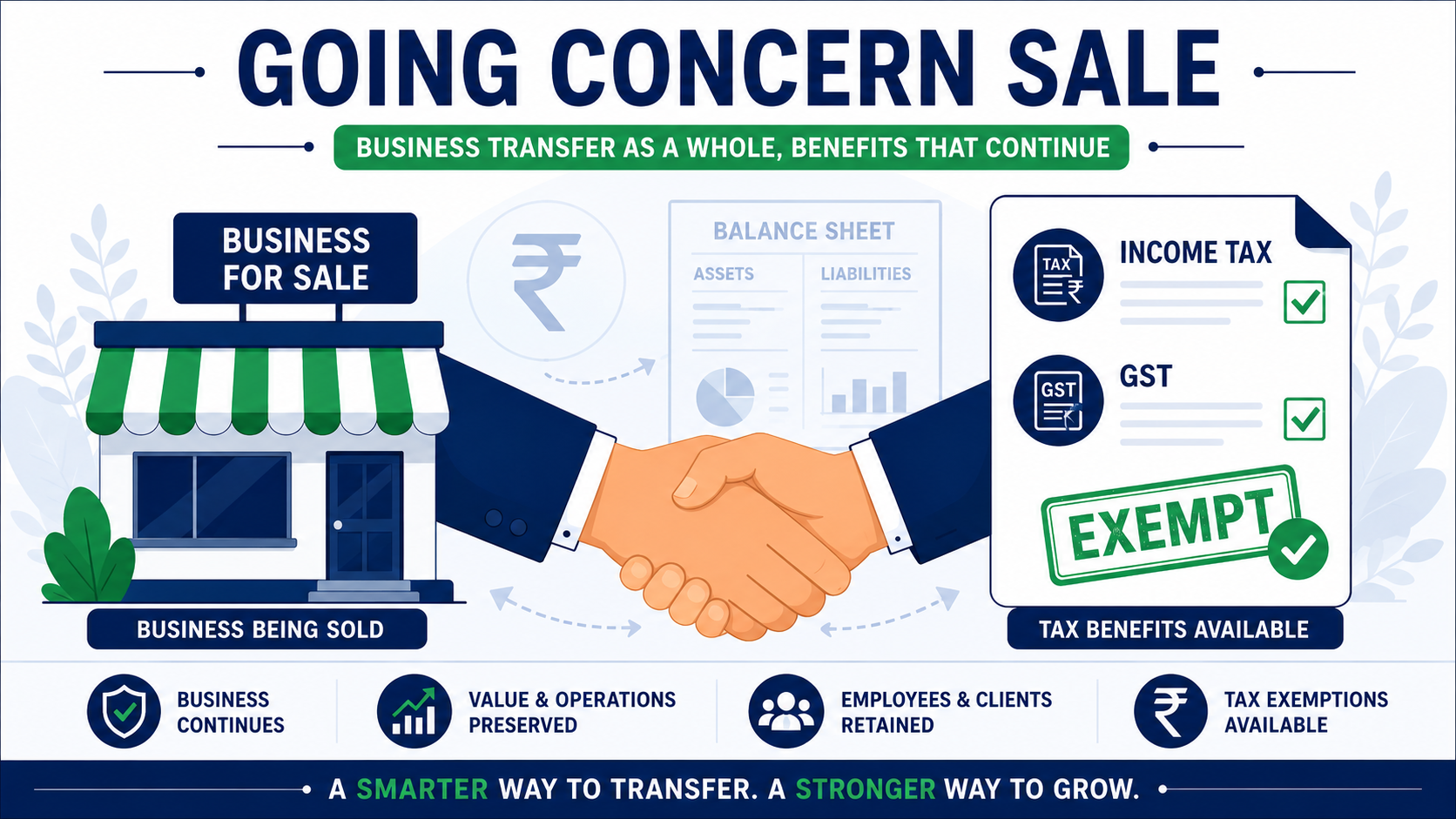
This is where many business owners are pleasantly surprised. The transfer of a business as a going concern is generally exempt from GST under Entry 2 of Notification No. 12/2017-Central Tax (Rate). However, this exemption applies only when:
- The business is transferred as a whole — as a going concern
- All key elements — employees, contracts, licences, debtors, creditors — are transferred together
If individual assets are sold separately instead of the business as a whole, this GST exemption does not apply.
4. Other Important Considerations
Before closing a going concern sale, keep these in mind:
- Valuation report — A professional valuation is advisable, especially for slump sales, to support the net worth computation and withstand scrutiny.
- Documentation — Transfer of licences, registrations, contracts, employees, debtors, and creditors must be properly documented and executed.
- Stamp duty — Depending on the assets transferred and the state of operation, stamp duty implications may arise. State-specific laws apply.
The Bottom Line: The difference between a slump sale and an itemised sale is not just a technicality — it determines which sections of the Income-tax Act apply, how your capital gain is computed, and whether the GST exemption holds. Structuring the transaction correctly before signing any agreement is far easier than correcting it after.
Planning a business sale or acquisition? Reach out to ASA and Company for a free consultation — we will help you structure it correctly from the start.