AIF investments have grown rapidly among HNIs and family offices in India. And with them comes a document many investors receive around tax season but don't fully understand: Form 64C. In my practice, I regularly see one mistake with it — the entire amount in Form 64C gets reported under "Income from Other Sources". That can mean paying significantly more tax than you actually owe. Here's what Form 64C really is, how the income in it is taxed, and how to report it correctly.
What Is Form 64C?
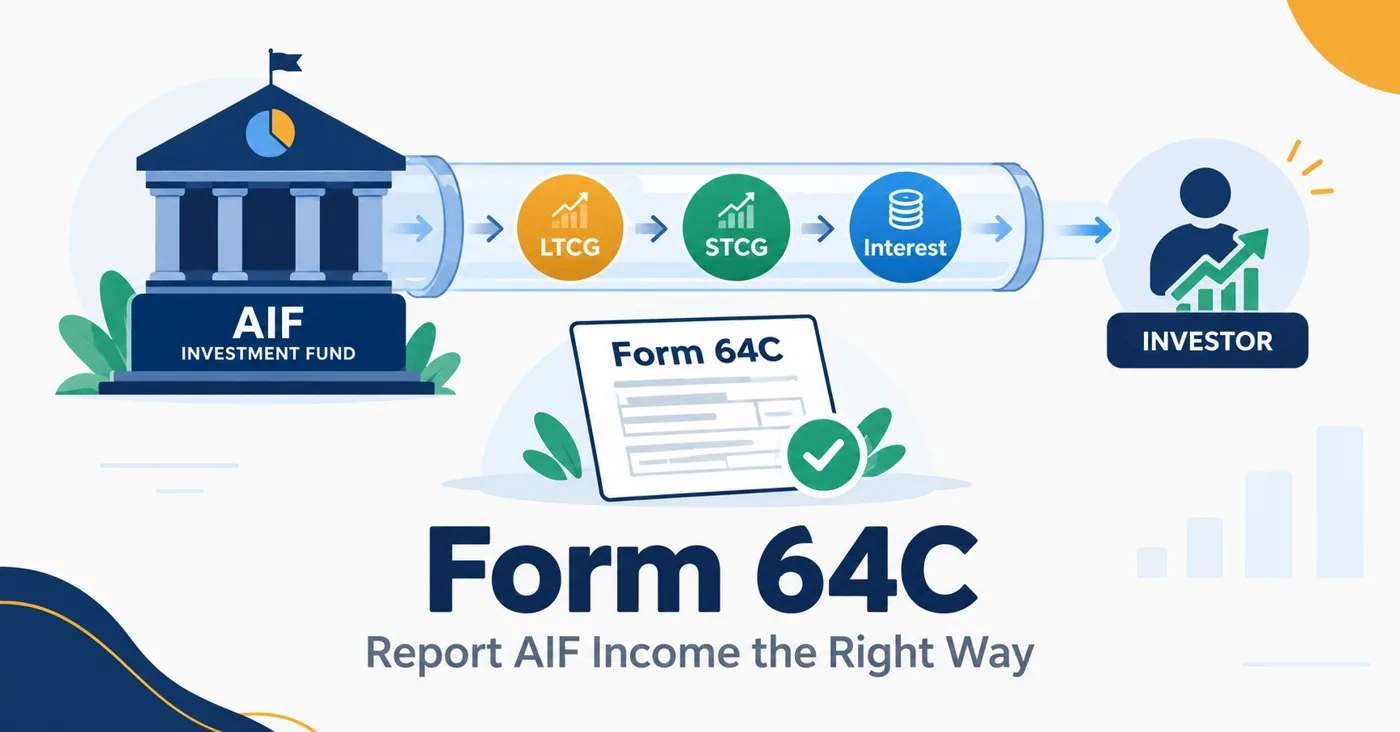
Form 64C is issued by a Category I or Category II Alternative Investment Fund (AIF) to its unit holders under Section 115UB of the Income-tax Act, 1961. It reports the investor's share of income distributed by the fund, or deemed to have accrued from it. Investment funds enjoy pass-through status — this means the income is generally taxed in the hands of the investor, not the fund, and it retains the same character it had in the hands of the fund.
How Is the Income in Form 64C Taxed?
The gains reported in Form 64C are not taxed under a separate provision merely because they appear in the form. Their taxability depends on the nature of the income reported.
| Nature of Income | Tax Treatment |
|---|---|
| Long-Term Capital Gain (LTCG) | Taxable as LTCG under the applicable provisions (e.g., Section 112 or 112A) |
| Short-Term Capital Gain (STCG) | Taxable as STCG under the applicable provisions (e.g., Section 111A or normal slab rates) |
| Interest Income | Taxable under "Income from Other Sources" or "Business Income", as applicable |
| Dividend Income | Taxable as dividend income in the hands of the investor |
| Business Income | Generally taxable at the AIF level (except in specified cases), and ordinarily not passed through under Section 115UB |
3 Things Every AIF Investor Should Know
- The character of income is retained. If the AIF earns long-term capital gains, the unit holder is treated as having earned long-term capital gains. If the gains qualify for a concessional tax rate or exemption, the investor can generally claim the same, subject to satisfying the applicable conditions.
- There is no double taxation. Income already taxed in the hands of the investor on an accrual or pass-through basis is not taxed again when it is actually distributed.
- Reporting happens in two places. Form 64C details should be reported in Schedule PTI (Pass Through Income) of the applicable ITR. The corresponding income must also be reported under its relevant schedule — Schedule CG for capital gains or Schedule OS for other sources, depending on its nature.
A Practical Example
Suppose your Form 64C reports:
- LTCG on listed equity: ₹8,00,000
- Interest income: ₹50,000
The correct reporting would be:
- ₹8,00,000 as LTCG in Schedule CG, with the applicable tax treatment under Section 112A or Section 112, as the case may be.
- ₹50,000 under Income from Other Sources.
- The pass-through details in Schedule PTI.
Had the full ₹8,50,000 been reported under "Other Sources", the capital gain would have been taxed at slab rates — and the benefit of the concessional LTCG rate would have been lost entirely.
The Bottom Line
While filing your ITR, do not treat the entire amount in Form 64C as "Other Sources" merely because it appears in one form. The nature of income mentioned in Form 64C governs its tax treatment, and each item should be reported under the appropriate schedule of your return.
Invested in an AIF and want clarity on reporting your Form 64C correctly? Reach out to ASA and Company for a free consultation. We help HNIs and family offices across Jaipur and India report pass-through income accurately — and keep every tax benefit they're entitled to.